Protecting Redwoods Before They Fragment
 SEMPERVOICES:
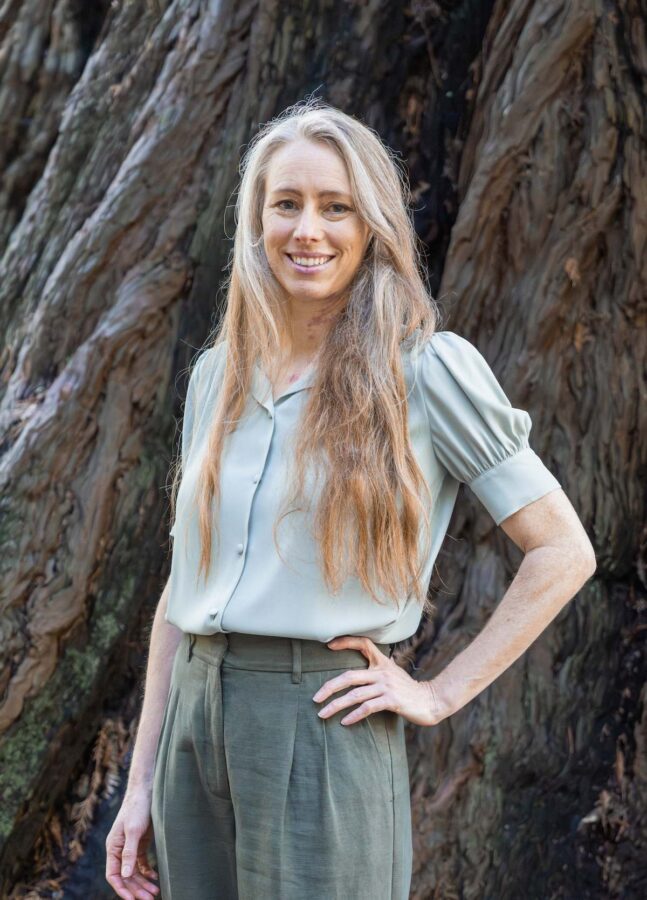
ADRIAN FREDIANI
DIRECTOR OF LAND TRANSACTIONS
Interview: Inside the Work of Protecting Redwoods
As Director of Land Transactions at Sempervirens Fund, Adrian Frediani’s work sits at the junction where conservation goals are forged into agreements that hold up financially, legally, and endure the test of time. Her team is charged with buying land, selling land, and helping move properties into long-term protection. In the Santa Cruz Mountains, where development pressure, working lands, public access, and ecological value overlap, the work is not as simple as identifying a property and acquiring it. For Adrian, real estate is also a practical tool for stewardship. Protecting land at the right scale can create the access, continuity, and management conditions needed to maintain roads, address invasive species, reduce fuel loads, and support the long-term recovery of redwood forests.
We spoke with Adrian about why fragmentation is so hard to reverse, what made 2025 a building year for future conservation, and why keeping redwood forests as redwood forests is often the most important goal of all. By keeping forests intact, we can implement forest health treatments more efficiently and effectively.
In 2025, what is the biggest priority for the Land team at Sempervirens?
Our biggest priority is still protecting redwood forests, especially the remaining old-growth. But the larger goal is to keep redwood forests intact and prevent them from being converted to more intensive uses. The moment a forest is subdivided and developed, you have altered that landscape in a way you cannot undo.
That matters because redwood forests are dynamic, living systems. Large, connected blocks of habitat, intact watersheds, and wildlife corridors help buffer drought, fire, and climate stress. Once that continuity is interrupted, it is extraordinarily difficult to restore. At the most basic level, our work is about preventing that irreversible shift. We are trying to keep redwood forests as redwood forests. And just as importantly, by protecting land at a meaningful scale, we help ensure these forests can be cared for over time through active stewardship. By keeping natural lands connected, we can implement habitat restoration and management treatments more effectively.
So, if I understand correctly, not every important property is an obvious old-growth protection story?
Some places are clearly significant because they contain old-growth, endangered species habitat, or enhance access to State Parks. Those are the straightforward cases.
It is important for us to see the comprehensive value of natural lands and the ecological lift they provide at a watershed and landscape level rather than zeroing in on the property alone. A small stand of redwoods surrounded by subdivision may still matter, but it cannot do the same work as a larger block that connects to parks, working timberlands, and waterways. That is why we look beyond individual parcels and ask a broader question: what larger ecological story does this land support, and what happens if that continuity is lost? We have spent a lot of time considering that second question, which has led us to identify fragmentation as the greatest threat to redwood forests today.
Could you share a particular property that your team has worked on in 2025 that has shaped some of the priorities you have talked about?
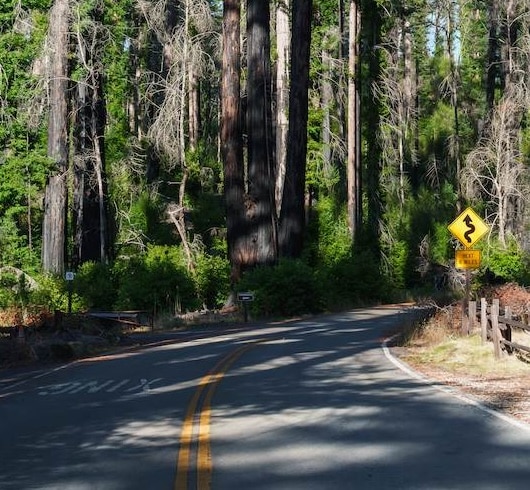
The Gazos watershed comes to mind. The region represents one of the largest remaining expanses of relatively intact forest in the Santa Cruz Mountains. There are properties with tens of acres and others that span thousands of acres. Some are working lands, others include creek corridors, and some border existing conservation lands, which speaks to the many roles this landscape plays, and the many people whose decisions will shape its future. Our hope is to work with the community to find shared goals that keep the ecological processes of forestlands functioning at a meaningful scale, while honoring the diversity of the people connected to them.
How does Sempervirens build relationships within such a diverse community?
Community-building begins with how we show up. In a place like the Gazos, that means being a good neighbor, being consistent, and recognizing that conservation work happens within a real community with shared concerns and long memories.
Sometimes that work is very tangible. Road maintenance is a good example. It may sound small, but it affects everyone because roads shape how people move through a landscape. Access, infrastructure, stewardship, and land management are shared realities, and how we participate in them matters.
It also means investing in relationships over time. Trust is built through listening, patience, and follow-through. In the Gazos, that has included years of relationship-building with landowners, families, and community members. Those relationships are not separate from the conservation work. They are what make the conservation work possible.
 Could you speak more to your role? Once a priority property like the Gazos watershed is identified, what does your team actually do to move a deal forward?
One thing I always want to clarify is that my team is not tasked with deciding which lands are priorities. Those priorities are shaped by leadership, conservation planning, stewardship, and the relationships Sempervirens staff are building across the landscape through community engagement.
My team’s role begins once a property has been identified as important. At that point, our job is to figure out how to move protection forward. That can mean structuring the transaction, negotiating terms, coordinating with landowners and partners, and making sure the deal is financially responsible and operationally feasible. In that sense, we are service providers. Our responsibility is to deliver on priorities identified by our organization in a way that is practical, transparent, and effective.
After one deal is completed, how does that momentum carry into future transactions through credibility, stronger partnerships, or lessons learned?
It carries forward in all of those ways. Every transaction teaches us something about how to do the next one better, whether that means improving internal coordination, understanding a partner’s process more clearly, or navigating a similar transaction structure with greater efficiency.
Just as importantly, we strive to show up with the communities we buy land from in a transparent and collaborative way, so people feel confident in our organization as a partner. And of course, we aspire to demonstrate this ethos through how we steward the land after a deal is done.
What did partnerships with groups like State Parks teach you in 2025 that will make future land protection stronger?
Not every property is meant to remain with Sempervirens long term. In most cases, the best outcome is for us to acquire land and transfer it to a public partner like State Parks that is well positioned to manage it over time.
What 2025 taught us is that those partnerships require groundwork. They depend on understanding one another’s processes, aligning around shared goals, and building enough trust to move efficiently when the opportunity is right. It has been awhile since State Parks acquired new lands in the Santa Cruz Mountains and the work around the Gateway to Big Basin, also known as NoraBella, exercised that muscle. Working through that transaction with our State Parks counterparts helped to reestablish clear, durable pathways for transferring ownership to long-term landowners that are best suited to secure the future of these important lands.
 What would it look like, from your perspective, to truly “hit” these objectives moving forward?
It would look like meeting the ambition of the strategic plan. That includes what we talked about in terms of protecting vulnerable redwood forests before they are converted, preserving larger connected landscapes, and making real progress conserving regionally important old-growth, watersheds, and habitat.
It would also mean building the internal capacity to act effectively as a team and with our partners so that each conservation dollar goes as far as it can. We have a responsibility to the landscape and to the people who support our work. Our donors and public partners are entrusting us with resources to make thoughtful, strategic decisions, and part of truly hitting these objectives is making sure those resources are used in ways that achieve the greatest possible impact.
More to Explore
- Explore why keeping redwood forests connected matters for wildlife, watersheds, and long-term stewardship
- Read more about Sempervirens’ Strategic Plan to guide the next chapter of forest protection
- See how the Gateway to Big Basin expanded permanent park protection and future public access.