
Connecting Land and People Together
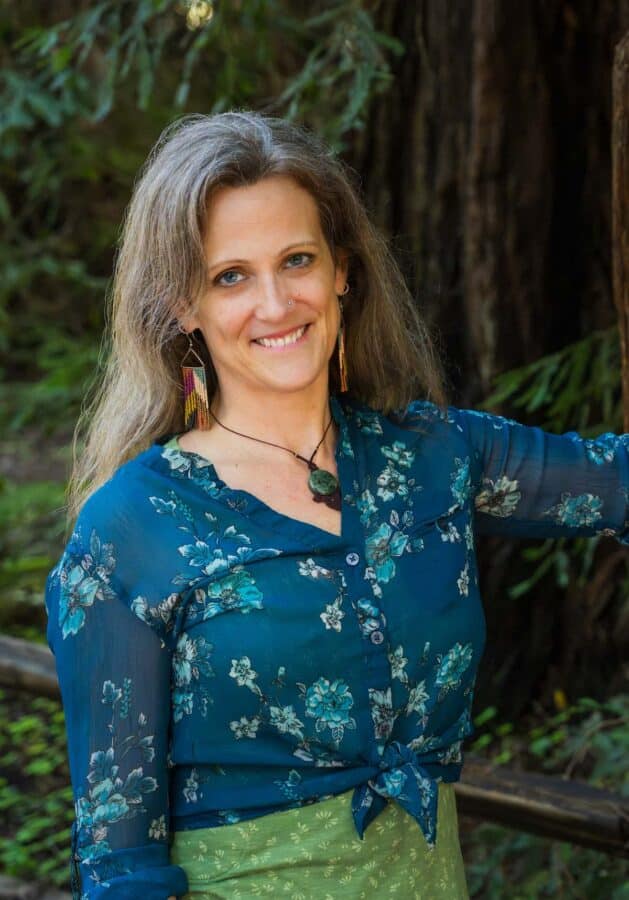 SEMPERVOICES:
LAURA MCLENDON
DIRECTOR OF CONSERVATION PLANNING
Interview: How People and Redwoods Grow Together
As Director of Conservation Planning at Sempervirens Fund, Laura McLendon is tasked with helping build the connective tissue between land, people, and institutions that ensure nature is cared for far beyond our lifetimes.
In this conversation, she reflects on how the relationship between people and the natural world has shaped her conservation work, how Sempervirens has changed over the past decade, and why redwood stewardship today must include public education, Indigenous partnership, and a deeper reckoning with fire, climate, and history.
When you think about Sempervirens today, what feels most different from what the organization was ten years ago?
If I look back to 2015, we were still a very small organization. I was the only staff person working across programs, transactions, and stewardship besides the executive director.
We were protecting land, often smaller properties, holding them for a time, then transferring many of them to California State Parks. We really functioned much more like a land trust than a conservation organization. Now, our role in stewardship is deeper and more integrated. We have a much clearer sense that you cannot just protect land and walk away.
What helped drive that shift?
Our continuous work at San Vicente Redwoods played an important role because it pushed us to understand stewardship at a landscape scale. It was such an enormous property, and it required a different level of attention, coordination, and long-term thinking than many of the smaller properties we had worked on before.
At the same time, we began recognizing more clearly that protected land across the region was being cared for by many different land managers who were not always in close coordination. That helped lead to Sempervirens Fund’s leadership in forming the Santa Cruz Mountains Stewardship Network. We could see how much green there was on the map across the bioregion, which meant there had been real success in land protection. But protection alone was not enough. The question became how we could collaborate more deeply around ecological health. And we began thinking more seriously about what it takes to care for landscapes over time.
How did that change Sempervirens’ role in the region?
Once you start thinking at the scale of a whole landscape, you realize resilience cannot be established one parcel at a time. Stewardship depends on partnership, shared learning, and coordination across ownerships and institutions. That changed our role in building relationships among land managers, public agencies, scientists, and communities so these places could be cared for well into the future.
How does Sempervirens define stewardship now?
We think of stewardship as a relationship with the land. It is a necessary part of conservation, and it is necessary to the survival and integrity of our planet and our species. I do not always love the phrase land management because the land is doing most of the work. I come back to an Indigenous idea, even as we describe it in Western terms, of tending the land. That is more of a reciprocal relationship where people are actually giving back and appreciating what they are receiving, not taking more than they need.
That matters because there is still a strong tendency to think of people and nature as separate. I am always trying to challenge that. From my perspective, the real question is, “What kind of relationship do we choose to have with the land?”
Why does that kind of connection matter so much?
Because many people grow up feeling like nature is distant or unfamiliar. If you do not grow up camping, hiking, or visiting parks, the outdoors can feel intimidating. I have worked with kids who did not want to get dirty, who were worried about tripping, or who thought there might be a bear nearby even though we do not have bears here. But once they begin to feel comfortable, something changes. Curiosity takes over. Joy takes over. You can barely keep them on the trail! That kind of connection matters because it changes how people understand the natural world and their place in it.
Did the 2020 CZU Lightning Complex Fire change how people understood their responsibility to this landscape?
Absolutely. The wildfire and the pandemic together were another huge pivotal moment for our community. For a long time, conservationists often treated nature as if it were a pristine museum. But that is not how nature works. Nature changes. Disturbance is normal. Fire is part of these systems.
The problem is not fire itself. The problem is how we altered these landscapes, interrupted Indigenous tending practices, and protected nature in ways that unintentionally made the consequences worse. If cultural burning had not been interrupted, the fire likely would not have been as destructive. The lesson is not that people should step away from the land. It is that we need to rebuild a more responsible relationship with it.
How did that lesson take shape in 2025?
Because the fire destroyed so much of Big Basin’s infrastructure, State Parks had the opportunity to step back and rethink how the park should be rebuilt. Their Reimagining Big Basin plan, which they released in 2025, answers important questions about where infrastructure belongs, how to reduce impacts on the landscape, and how to rebuild, restore, and reconnect with greater climate resilience.
What felt important to me in 2025 was that this work became much more visible. The planning process brought more voices into the conversation. It created more opportunities to explain why recovery takes time, why protected lands still need active care, and why fire, restoration, monitoring, and public access all have to be considered together. It also gave Sempervirens a clearer role as a connector between the park and the public, helping people understand what is changing, why it is taking time, and what long-term stewardship really requires.
I also think 2025 made clear that rebuilding a park has to include the long-term stewardship that will support it over time. That is part of why efforts like the expansion of Norabella, also referred to as the Gateway to Big Basin, feel so significant. Beyond adding to the footprint of the park, expanding and supporting state parks creates the conditions for care and access long term.
What helped Sempervirens lead to this clearer understanding?
One major shift was that we intentionally started engaging with the Amah Mutsun Tribal Band and helped support the formation of their land trust as a nonprofit in 2015. That was transformational. It helped more and more people inside the organization understand what a functional relationship with the land could be. It also shed light on how much conservation and social justice overlap.
You cannot separate people and culture from nature, environment, and conservation. You just cannot. I think more and more conservationists, scientists, and researchers are realizing that. That understanding has changed how we think about partnership, responsibility, and what conservation work should include.
What feels possible in 2025 that did not feel possible ten years ago?
What feels possible now is a more intentional future, one where land protection, stewardship, public engagement, and institutional partnership are working together in service of forests that can last far beyond our lifetimes.
There is a real desire right now for people to feel that they are doing something meaningful and positive for the world, and redwoods speak directly to that. They teach us that we are not separate. They inspire wonder and make people feel small in a way that is grounding and humbling. They invite a different sense of scale, time, and responsibility. That is the deeper connection: redwoods do not just connect people to nature. They help dissolve the illusion that we were ever separated from it at all.
More to Explore
- Learn how Indigenous knowledge and cultural fire are helping shape redwood stewardship at San Vicente Redwoods
- Explore how Sempervirens envisions a more climate-resilient, welcoming future for one of California’s most iconic parks
- Discover how welcoming more people outdoors helps deepen connection, health, and belonging in redwood forests